
The whole is greater than the sum of its parts. It is only through the parts that the whole gets delivered.
— Michael Wolff, Intel Visual Life
Intro Design, Julian House and Adrian Talbot
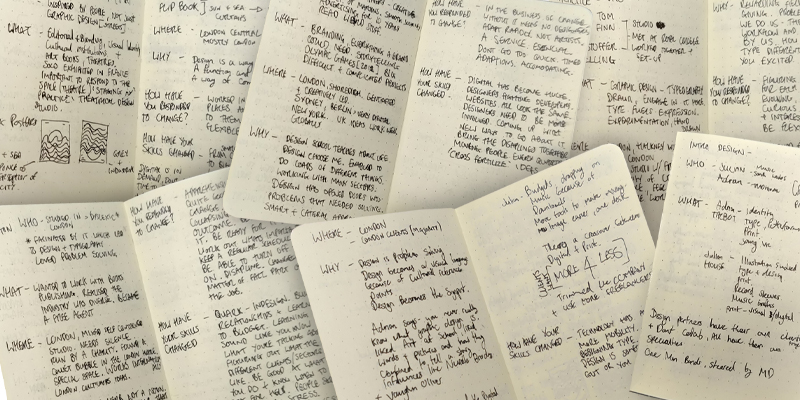
Men of little words, Julien and Adrian of Intro Design shocked me with their studio lives. My experience has always taught me that collaboration and teamwork produces better results. These two flipped that on its head. Design partners within the studio all have their own clients and specialities, rarely collaborating. A team of one-man bands, steered by a central Managing Director. I love the way they talk about what design was for them in the beginning. It resonated with me. “You never really know what graphic design is when you first get into it. I liked art at school. I like using words and pictures to tell a story.” I had no idea what design was. I liked making things, messing around on the computer. I was designing for myself until I found out more and that design was better used to help others.
Sarah Boris
A real global designer, Sarah believes that design is a way of life. I liked the way that she describes her favourite work. How a happy accident tied it all together. That’s what design is sometimes. I don’t think I’ve ever gone into a project with the desired outcome that was 100% the same as the actual outcome. It’s those happy accidents that make you a better designer. You can’t learn if you already know it all. Sarah has worked in multiple countries and has had to adapt and be flexible with her work. She’s also worked in completely different sectors and had to change the way she designs. It’s important to design in response to the client and the brief.
Regular Practice, Tom Finn and Kristoffer Soelling
Huge typography nerds. It shows in their work. Their knowledge of the intricacies of letterforms is great and they use it n all aspects of their work. Typography fuels expression and experimentation. I admire that at a young age they know exactly the type of work they want to do as a practice and are extremely happy to stick with it and evolve it. As they had no business experience when they started they have made plenty of mistakes. With optimism and curiosity, they are learning one step at a time what it means to own a practice and what a practice means to them.
Sam Winston
Sam for me is a curious case. He found a love of design through his dyslexia. Because he had to problem-solve his writing, he fascinated over it and it gave him great joy to problem solve. He originally wanted to work for a publisher as he didn’t see many other options for himself. Sam realised that the industry was diverse and he could do whatever he wanted. So naturally, he started working for himself as a free agent. Sam surprised me with his response to change. He would mitigate as much as he could so that he can keep doing what he wants. He argues that change is part of the job and that you have to battle that and remain disciplined. I got the impression that he loves what he does specifically and wouldn’t want to change it.
SomeOne, Simon Manchipp
I just became a big fan of Simon. SomeOne is the most global of all of these case studies. As a traveller, it resonates with me. With an emphasis on storytelling, collaboration and exploration. I love the quote “We are in the business of change, without it means there would be no need for design”. We have to embrace the change and challenge ourselves. Without change, design would be boring. He goes on to say that “design opens the door to projects that need solving”. Design is an incredible career and we are lucky to work with so many diverse clients in so many industries. I don’t think that designers should be separated from other parts of the business. Designers are problem solvers. Use them. It’s great that SomeOne moves around everyone in the office so that different teams can “Cross fertilise ideas”, bringing the disciplines together.
Conclusion
Each person or agency has a ‘niche’. Branding, typography, publishing, music. It was interesting to see that each one found an area in which they were extremely good at and stuck with it, getting better and better, never taking on jobs that aren’t them. All agree that design is not just about words or images on a page that look nice. Design is about telling a story. All of them agreed that the rise of digital has changed the way they design. It’s hard for predominantly print designers to become specialists in digital so collaboration with digital specialists is key.
 mbetts.design.blog